


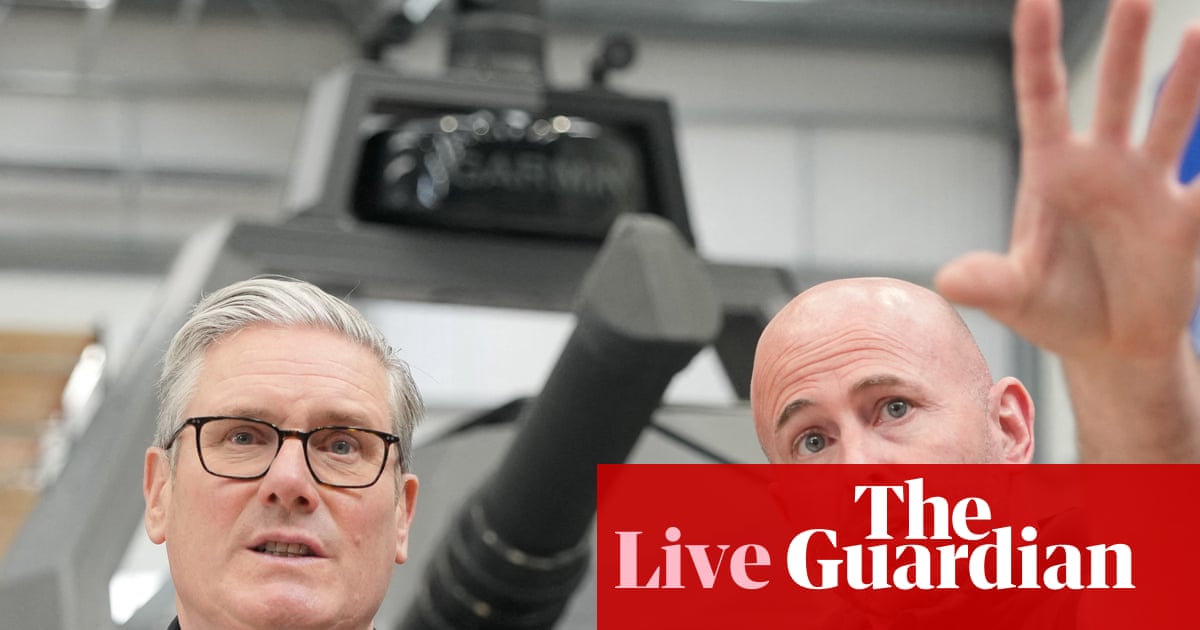
Starmer said he ‘will fight’ any leadership challenge, not out of ‘stubbornness’ but from ‘deep sense of duty’
Keir Starmer has said that he will fight to keep his job if he faces a leadership challenge.
In an interview with Chris Mason, the BBC’s political editor, Starmer also defended his proposals for the defence investment plan (Dip) saying that he did not accept it was underfunded.
On the leadership, he said:
I want to complete the work I was elected into government to do. And therefore that’s why I’ve always said I’m not going to walk away from the commitment that I made in 2024 to serve my country and the mandate that I won from the British public in order to do so.
That was a mandate we won in 2024 with me then leading my party and me now as prime minister.
I’m not going to walk away from that because I think it’s very important that we carry on ensuring that we do the right thing.
Starmer said he thought it would be a mistake for Labour to “plunge the country into the chaos of a leadership election”.
But, if there is a leadership challenge, “I will fight,” he said.
That’s not about personal vanity, it’s not about stubbornness, it’s out of a very deep sense of duty.
I will post more quotes from the interview shortly.
Key events
US under secretary of defence backs John Healey’s call for higher UK defence spending
Elbridge Colby, the US under secretary of defence for policy, has posted a message on social media reposting John Healey’s resignation letter and suggesting that he agrees with Healey’s call for the UK to spend more on defence. Colby says:
The United Kingdom has an extraordinarily proud military history. It commands our respect. There is again a great need for more British military strength in this critical time. We urge the UK to meet that need with urgency, scale, and determination. 1/
Donald Trump, the US president, has long been calling for all Nato members to spend more on defence.
Starmer rejects claim Dip funding inadequate, and says defence will be ‘a number one priority’ in next spending review
Keir Starmer has rejected claims that he is not ploughing enough money into the defence investment plan.
This is the claim that led John Healey to resign as defence secretary yesterday. But, in his interview with the BBC’s Chris Mason, Starmer said he was putting “considerable” money into defence.
Asked about claims from generals like Sir Richard Barrons about the Dip being under-funded, Starmer replied:
I have the highest respect for the individuals that you have quoted, but I don’t agree. These are hard-edged decisions and we are seen as a leading member of Nato.
Starmer also said defence would be his “number one priority” at the next spending review. He said:
We have another spending review coming up and before the end of this parliament, and defence will be a number one priority in that space.
Starmer said he ‘will fight’ any leadership challenge, not out of ‘stubbornness’ but from ‘deep sense of duty’
Keir Starmer has said that he will fight to keep his job if he faces a leadership challenge.
In an interview with Chris Mason, the BBC’s political editor, Starmer also defended his proposals for the defence investment plan (Dip) saying that he did not accept it was underfunded.
On the leadership, he said:
I want to complete the work I was elected into government to do. And therefore that’s why I’ve always said I’m not going to walk away from the commitment that I made in 2024 to serve my country and the mandate that I won from the British public in order to do so.
That was a mandate we won in 2024 with me then leading my party and me now as prime minister.
I’m not going to walk away from that because I think it’s very important that we carry on ensuring that we do the right thing.
Starmer said he thought it would be a mistake for Labour to “plunge the country into the chaos of a leadership election”.
But, if there is a leadership challenge, “I will fight,” he said.
That’s not about personal vanity, it’s not about stubbornness, it’s out of a very deep sense of duty.
I will post more quotes from the interview shortly.
No 10 says there’s no ‘zero sum choice’ between welfare and defence spending
At the Downing Street lobby briefing the No 10 spokesperson rejected claims that the government faces a “zero sum choice” between defence funding and welfare spending.
She said:
There isn’t a zero sum choice here. Over the spending review and before the Dip [defence investment plan], the defence budget has been growing faster than any other major government department.
We are investing in defence and reforming the welfare system and I would point out that the last government did neither.
The Conservative party and Reform UK claim that higher defence spending (indeed, almost any prospective extra government spending if you listen to some of their rhetoric) could be funded by benefit cuts. (Previous governments has found slashing welfare is not as easy as it sounds.)
In an interview on the Today programme this morning, Al Carns, who resigned as armed forces minister last night, hinted he had some sympathy with calls for lower welfare spending. He said
There is an argument around welfare. I’m a firm believer that it’s about hands up, not hand out.
But we need to help the people who need the most help within the nation, but also get the balance right across defence. That’s a difficult circle to square, as we’re finding.
But government ministers also insist that the welfare system should be about helping people to go back to work if they can.
Dan Jarvis, the new defence secretary, is in Swindon for the opening of the new drone testing facility, No 10 has confirmed. (See 12.36pm.)
No 10 says Dip still being finalised – but won’t reveal if Jarvis insisted on more funding before taking defence secretary job
Downing Street has confirmed that the defence investment plan (Dip) is still being finalised – but refused to say whether Dan Jarvis insisted on more money being allocated for it as a condition for taking over as defence secretary last night.
In his resignation letter, John Healey said the funding set aside for the Dip was “well short” of what was needed and he suggested Keir Starmer had given up trying to get more money out of the Treasury to fund it.
At the Downing Street lobby briefing, a No 10 spokesperson said the plan was still being finalised – implying final spending totals are still up for negotation.
She said:
Work to finalise the defence investment plan continues at pace with the new defence secretary and the prime minister has been clear that he is determined to publish it before the Nato summit in July.
Asked whether the numbers given to John Healey on Monday were “set in stone”, the spokesperson repeated her answer.
Asked whether Starmer and Jarvis were agreed on the amount of funding the plan needed, she said:
The prime minister has been working with his team on this plan for months … No one’s shying away from the fact that this is about hard decisions, and we’re looking at a 10-year period ahead, and we must take the time to get that right, and that is what we are doing.
The spokesperson also rejected claims the government had been putting off tough decisions on defence by “backloading” commitments on spending (a claim made by Healey in his resignation letter). Asked if this was the case, the spokesperson replied
No, I reject that.
And I would just remind you of what our commitments are on defence spending: increasing defence spending to 2.6% next year, with the aim of increasing it to 3% in the next parliament when fiscal conditions allow.
So we have committed to that and we’re also committed to the Nato target of reaching 3.5% of GDP by 2035.
Originally the defence secretary was meant to be in Swindon today for a media event at a new drone testing centre. But the event was planned on the understanding that John Healey would still be in office. After he resigned, the media were un-invited.
Some sort of event is still taking place, but we’re rather short on details. Deborah Haynes, Sky News’s defence and security editor, has been in Swindon this morning, but was stuck outside the gates and did not sound very happy about it. The Swindon Advertiser is running a live blog, but without media access it’s a bit short on updates.
This is awkward because this was meant to be a big investment story. The new drone testing centre is described as the largest of its kind in Europe.
If you are curious as to why Swindon has emerged as a centre for drone expertise, the Economist explained why in this recent article. Here’s an excerpt.
The town of 230,000 people has already attracted Tekever, a Portuguese dronemaker, which is investing £400m there and will start producing advanced surveillance drones later this year. Stark, a German startup, is assembling loitering munitions capable of carrying a 5kg payload. Smaller firms, including Flyby Technology and Munin Dynamics, are moving in. Empty aircraft hangars ten miles south at a former air-force base are being prepped for testing drones. An MoD facility will lend a military cachet to the embryonic cluster …
Industrial decline has its benefits. Empty warehouses have dragged industrial rents down. Drone firms, keen to move fast, prize brownfield sites, those setting up locally say. Workers left adrift by the closure of a Honda factory following Brexit offer a pool of manufacturing know-how. Housing is relatively cheap. Firms also credit a YIMBY-minded local council with speedily stamping planning permits, and an energetic MP for courting defence firms.
Yet Swindon’s greatest asset may be its location. Mike Armstrong, who runs Stark’s British arm, says the town sits at the heart of Britain’s defence-aerospace corridor. London lies one way, Bristol the other, with a chain of military institutions dotted across the region.
Dan Jarvis has been tweeting about his new job. He says:
The defence of our nation is the first duty of government.
Our Armed Forces carry out that duty every day with professionalism, courage, and extraordinary skill.
It is a huge honour and a privilege to serve alongside them again.
Pro-Palestine activists believe ‘sea change’ coming in Labour’s approach to Middle East
Pro-Palestine activists believe there could be a “sea change” in the Labour party’s approach to the crisis in the Middle East which could result in the government taking a tougher stance on Israel, Patrick Wintour reports.
Earlier this week the Palestine Solidarity Campaign published polling showing that half of former Labour voters who are now backing another progressive party cite Gaza as a factor in their switch. In its write-up, the PSC says:
53% of voters who have switched from Labour to the Greens, the Liberal Democrats, the SNP, Plaid Cymru, and independents say Labour’s policy on Gaza was either a factor or a major factor in their decision to switch.
Green voters were the most likely to say Labour’s policy on Gaza was a factor, with over two-thirds (67%) saying it was a factor, including 30% who said it was a major factor …
Nearly three quarters (74%) of voters who have switched from Labour to other centre or centre-left parties since the 2024 general election say their opinion of Labour would improve if the next leader were to adopt a strong position on Palestine, such as imposing sanctions on Israel.
Tories praise Carns for condemning Northern Ireland Troubles bill as ‘unfit for purpose’
In his resignation letter Al Carns, the former armed forces minister, said the government’s Northern Ireland Troubles bill was “unfit for purpose”.
He explained:
The same instinct, that serious problems can be managed rather than faced, runs through the Northern Ireland legacy bill.
I have worked to fix the bill from the inside, but it remains unfit for purpose. It risks failing the very veterans it claims to protect. Men and women I served with, those I buried friends alongside, people who did their duty under conditions most individuals in Westminster will never have to imagine.
I set out the changes I believed were necessary, and the lines which I could not in good conscience go beyond. Those lines have not been accepted. I have run out of room to argue this case honourably from inside government. A serving minister cannot ask fellow veterans to trust a process he no longer trusts himself.
The bill will replace the Northern Ireland Troubles (Legacy and Reconciliation) Act passed by the last government. The Tory legislation gave an effective immunity to members of the armed forces and members of terrorist organisations facing prosecution over Troubles-era allegations, provided that they gave information about those incidents to a new reconciliation commission.
The act was welcomed by former members of the armed forces, but opposed by all the main parties in Northern Ireland. In broad terms, nationalists were unhappy about former soldiers being exempt from prosecution, and unionists were unhappy about the same protection being extended to former terrorists.
Labour says it is replacing the Tory law because it was not fair to victims and survivors and because it is potentially unlawful.
Carns always made it clear he was unhappy about the bill. But he did not resign when it was published last year. It passed its second reading last November, and is one of the bills carried over from the old session of parliament into the new one.
Carns’ comment about the bill echoes what the Conservative party has been saying about it. Last night James Cartlidge, the shadow defence secretary, praised Carns for resigning over this issue. He said:
Huge respect for Al Carns and the manner of his resignation – giving such a passionate and principled excoriation of Labour’s deeply damning NI Troubles Bill.
As he says, the Bill is “not fit for purpose” and betrays our veterans.
Up to 90% of Ireland’s asylum seekers may have entered from Northern Ireland, data shows
Up to 90% of asylum seekers in Ireland may have entered the country via the Northern Ireland land border in the last three years, figures suggest. Lisa O’Carroll has the story.