




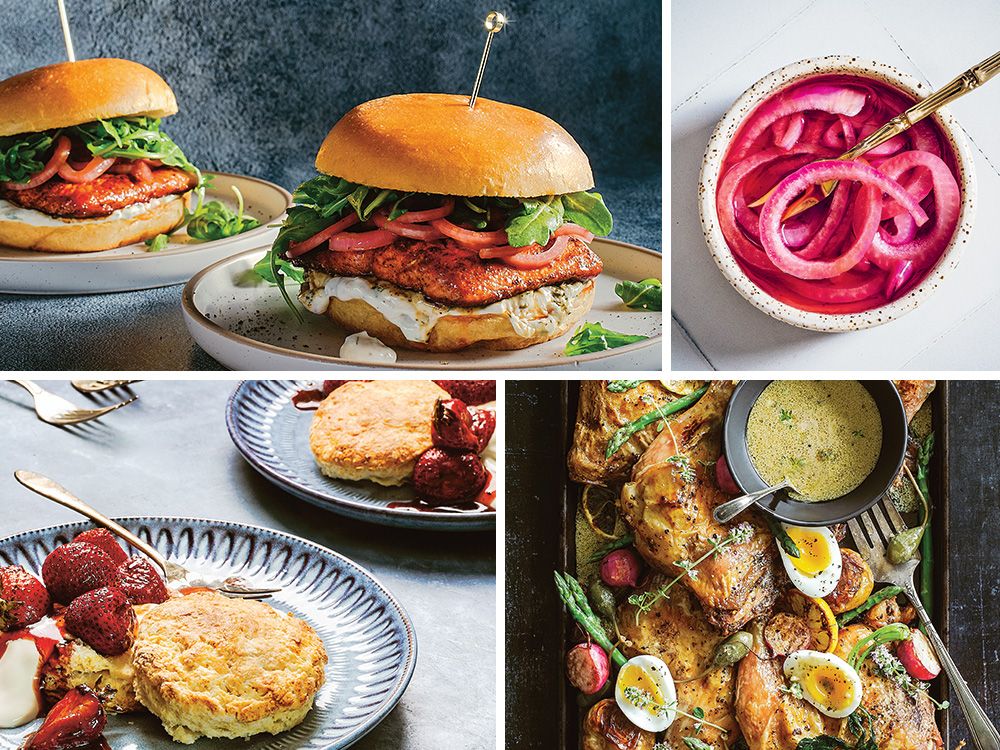
Our cookbook of the week is West Coast Kitchen Garden by Sabrina Currie.
Jump to the recipes: salmon burgers with dill caper yogurt , niçoise-style sheet pan chicken and balsamic roast strawberries with sweet cream .
For more than 15 years, Sabrina Currie ’s kitchen garden has been an excellent teacher, and she’s still learning from it. Lesson No. 1 has been patience. The Campbell River, B.C.-based cookbook author and former chef shares a spin on one of her favourite quotes: “The best time to have planted a fruit tree is 10 years ago. The next-best time is now.”
When Currie first planted her apple and fig trees, she felt like it would be an eternity before they bore fruit. A few years later, she was harvesting a bounty of produce to give away, preserve and roast. “Time moves along, whether you do something with it or not,” she says, adding that gardening has also provided a sense of reassurance that everything will be OK, whether it’s pollinators returning or regrowth after a forest fire.
“As things regrow, they regrow differently, but sometimes better. That’s a life lesson I try to tell my kids.”
Set alongside a highway, Currie’s front yard had been bothering her for a while before she transformed it into a kitchen garden. “I hated that we were watering this grass that wasn’t used because of the traffic noise.” Over four years, she converted the 100-by-20-foot lawn into a food-producing haven, reviving her culinary career and sparking the idea for her cookbook debut, West Coast Kitchen Garden (TouchWood Editions, 2026).
Currie grew up in a fishing family in Port McNeill, on the northeast coast of Vancouver Island. Her father taught her to smoke and sun-dry fish, and what to do with bycatch (marine animals caught unintentionally), and her mother and grandmother showed her how to preserve fruit and can salmon. She enrolled in the culinary program at North Island College out of high school and loved it immediately. “It lit a fire that never died.”
She went on to cook in logging camps and restaurants. Thirty years ago, there weren’t many high-end spots on Vancouver Island, and pay and opportunities were limited. “As I became a mother, it wasn’t practical anymore. So, I had a break from it, but I always felt like I would somehow get back into it.”

Currie’s kitchen garden brought her back. She launched a blog in 2018 as a creative outlet, and has since carved out a full-time career as a food photographer, writer, stylist and recipe developer. With West Coast Kitchen Garden, Currie hopes to encourage people to eat seasonally, whether by growing their own food or buying from local farmers.
“Gardening doesn’t need to be daunting,” says Currie, adding that growing herbs is a gateway. “A little bit of mint over your beans, a little bit of parsley on your meat, a little bit of basil on your salad. That little bit pinched from your herb grower elevates things so much.”
The book is organized seasonally, featuring gardening tips and recipes using homegrown produce and other local ingredients. It centres on the West Coast, but Currie highlights that most of the vegetables, fruits and berries are available across the country. For the regionally specific elements, she recommends readers think locally.
“If you go to the farmers market or even your grocery store, look for local things and enjoy what’s local. On the East Coast, something I put prawns in, use that lobster. On the Prairies, if I use venison, use beef.”
After more than a decade tending to her kitchen garden, Currie appreciates the space as a source of inspiration, opportunity and an antidote to stress.
“Getting out in my garden is huge therapy for me. Sometimes I have no energy, and I’ll think, ‘Oh, I’ll have my coffee here, or I’ll just sit here,’ then I see a weed. ‘I’ll just pull that weed. Oh, this plant needs watering. I’ll just water that. Oh, this one needs to be repotted.’ And all of a sudden, it snowballs, and I’ve been out there for an hour, and I feel light. Everything has melted away,” she says.
“I look back on the journey that it’s taken me on, and I feel so thankful to have had the opportunity, and that it has blossomed into a career.”
SALMON BURGERS WITH DILL CAPER YOGURT

Serves: 4
Salmon burgers:
1 tsp (5 mL) sweet paprika
1 tsp (5 mL) dried oregano
1/2 tsp (2.5 mL) salt
1/2 tsp (2.5 mL) ground black pepper
1/4 tsp (1 mL) cayenne pepper
4 x 6 oz (4 x 175 g) boneless salmon fillet portions
4 burger buns
4 tsp (20 mL) butter or margarine
2 cups (500 mL) arugula
4 tbsp (60 mL) drained pickled onions ( see recipe )
Dill caper yogurt sauce:
1 tbsp (15 mL) minced shallot
1 tsp (5 mL) caper vinegar
1 cup (250 mL) Greek yogurt
1 tbsp (15 mL) capers
2 tsp (10 mL) chopped dill
1/4 tsp (1 mL) salt
1/4 tsp (1 mL) ground black pepper
Make the salmon burgers
Step 1
In a small bowl, mix the paprika, oregano, salt, pepper and cayenne together. Sprinkle evenly over both sides of the salmon.
Step 2
Preheat a grill or heavy frying pan to medium-high heat. Brush with vegetable oil and then add the salmon and sear. Once the salmon has seared, cook it to your desired doneness, or about 3 minutes on each side.
Make the dill caper yogurt sauce
Step 3
Place the shallot and vinegar in a small bowl and stir together. Add the yogurt, followed by the capers, dill, salt and pepper, and stir until well combined.
Finish the burgers
Step 4
Slice the buns in half and spread a scant amount of butter on each cut side. Spread a generous amount of yogurt sauce on the bottom buns and then place a piece of salmon on each. Top each with 1/2 cup (125 mL) of arugula, 1 tablespoon (15 mL) of drained pickled onions and then the top bun.
PICKLED ONIONS: QUICK OR CANNED

Makes: 4 (1-pint/500 mL) jars
4 cups (1 L) red wine vinegar
3 tbsp (45 mL) pickling spice or 6 sprigs of fresh thyme
7 cups (1.75 L) sliced red onions (about 6-7 medium-sized onions)
Step 1
Sterilize your jars and lids.
Step 2
In a large saucepan, combine the vinegar and the pickling spice or thyme, if using.
Step 3
Bring the mixture to a boil over medium-high heat. Add the sliced onions, stir and bring back to a boil for 5 minutes.
Step 4
Using a slotted spoon, remove the onions from the cooking liquid and pack them into the sterilized jars. Pour the hot pickling liquid into the jars to cover the onions, leaving 1/2 inch (1.25 cm) of space below the rims. Centre the lids on the jars and screw on the rings until they are fingertip tight.
Step 5
For quick pickles, just let the jars cool on the counter and then put them in the refrigerator.
Step 6
For canned pickles, wipe the rims with a clean damp cloth and top with sterilized canning lids. Screw the lid bands on and place the jars in the water canner. Place the lid on, bring the water back to a boil over high, and, once it’s boiling, set the timer for 10 minutes. Turn off the heat and let the water cool for 5 minutes. Place the jars on a dry towel or rack. Let them cool for 12-24 hours.
Step 7
Once cool, check the lids for a good vacuum seal by pressing on the centre of each one. The lids should be slightly concave, and when pressed, they should not pop down or up. If any do not seal (which sometimes happens if the jar rim wasn’t perfectly clean), store them in your refrigerator and use them first.
Step 8
Canned pickled onions will keep well in a cool, dark place for up to a year. Once opened, they will keep for 2 weeks in the refrigerator.
NIÇOISE-STYLE SHEET PAN CHICKEN

Serves: 4
Chicken marinade:
3 tbsp (45 mL) caper juice
2 tbsp (30 mL) olive oil
2 cloves garlic, minced
6 large sprigs of thyme
1 tsp (5 mL) dried oregano
1 tsp (5 mL) fine salt
1/2 tsp (2.5 mL) ground black pepper
Pan roast:
4 bone-in chicken legs (skin on, drumstick and thigh attached)
2 cups (500 mL) new potatoes
1 cup (250 mL) radishes
1 cup (250 mL) asparagus (about 8-10 spears)
1 lemon, sliced into 1/4-inch (0.5-cm) rounds
Garnish:
4 soft-boiled eggs, peeled and halved
2 tbsp (30 mL) drained capers
1/2 cup (125 mL) Niçoise olives
Dressing:
1/4 cup (60 mL) extra virgin olive oil
2 tbsp (30 mL) sherry vinegar or red wine vinegar
1 tbsp (15 mL) Dijon mustard
1 anchovy fillet
1 clove garlic, minced
2 tbsp (30 mL) minced shallot
1 tsp (5 mL) coarsely chopped fresh thyme leaves
1/2 tsp (2.5 mL) fine salt
1/2 tsp (2.5 mL) ground black pepper
Marinate the chicken
Step 1
To make the marinade, combine the caper juice, olive oil, garlic, thyme, oregano, salt and pepper in a large bowl or resealable bag. Add the chicken legs, seal the bag and mix the marinade around well. Place the bag in the refrigerator for at least 1 hour, and up to 1 day before you plan to cook the chicken.
Cook the chicken
Step 2
Preheat the oven to 400F (200C). Line a large, rimmed baking sheet with parchment paper or aluminum foil.
Step 3
Remove the chicken from the marinade, shaking off any excess, place it on the prepared baking sheet, and slide it into the oven.
Step 4
Meanwhile, wash and halve the potatoes, wash the radishes and halve any large ones, and trim the woody ends off the asparagus.
Step 5
Once the chicken has been cooking for 20 minutes, remove the tray from the oven and add the potatoes, radishes and lemon slices, tossing them in the drippings. Return the tray to the oven and cook for another 20 minutes. Add the asparagus, toss it with the other veggies, and return the tray to the oven for 10 more minutes.
Prepare the garnish
Step 6
While the chicken is cooking, boil a pot of water and prepare an ice bath.
Step 7
Lower the eggs gently into the boiling water and boil for 6-7 minutes, depending on how soft you want the yolks. Transfer them to the ice bath for 5 minutes to stop the cooking. Peel and set aside.
Make the dressing and assemble the dish
Step 8
In a small bowl, whisk together the oil, vinegar, mustard, anchovy, shallots, thyme, salt and pepper.
Step 9
Once the chicken is cooked, leave it and the vegetables on the baking sheet, top with the capers, olives and halved eggs, then drizzle the dressing over and serve it family-style.
Cook’s note: This recipe can easily be doubled, but you’ll need an extra baking sheet so the ingredients aren’t overcrowded.
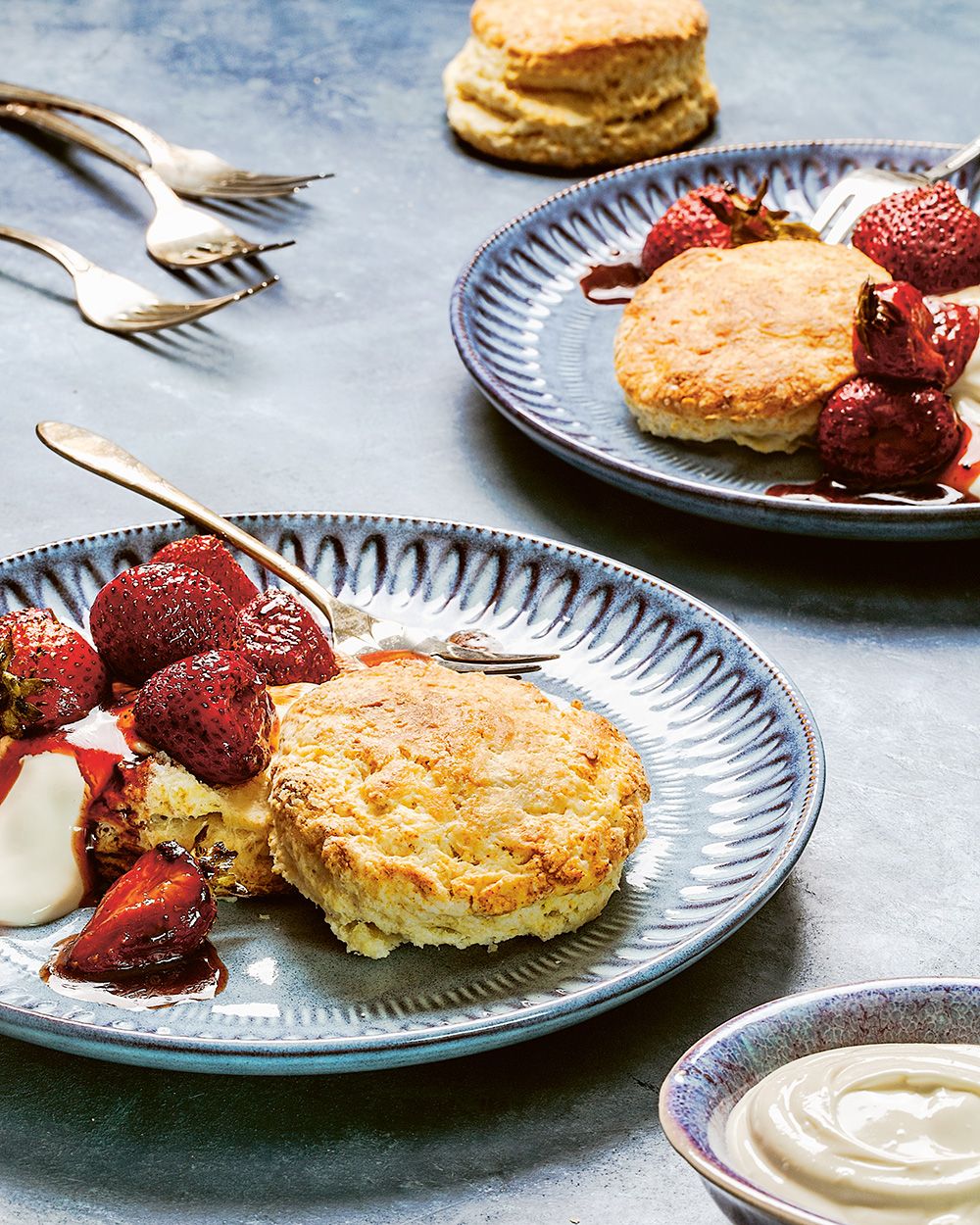
BALSAMIC ROAST STRAWBERRIES WITH SWEET CREAM
Serves: 4
1 1/2 lb (750 g) strawberries
3 tbsp (45 mL) balsamic vinegar
2 tbsp (30 mL) honey
1/4 tsp (1 mL) ground black pepper
3 tbsp (45 mL) brown sugar
Pinch of salt
2 tsp (10 mL) vanilla extract
1 cup (250 mL) sour cream
Biscuits , optional
Step 1
Preheat the oven to 350F (175C). Line a rimmed baking sheet with parchment paper.
Step 2
Trim the stems off the strawberries, leaving a few nice ones for garnish if you like, as they’re edible. Place the strawberries on the prepared baking sheet. Drizzle the balsamic vinegar and honey over top and sprinkle with the pepper. Toss to coat and spread them evenly around the tray. Roast, stirring the berries once at the 10-minute point, until sweet and somewhat shrunken, 20 minutes.
Step 3
In a small bowl, stir the sugar and salt with the vanilla together to dissolve. Fold in the sour cream.
Step 4
Divide the sweet cream among four serving bowls. Top with warm roasted strawberries and serve with biscuits on the side, if using.
Recipes and images excerpted from West Coast Kitchen Garden by Sabrina Currie. Reprinted with permission of TouchWood Editions .
Our website is the place for the latest breaking news, exclusive scoops, longreads and provocative commentary. Please bookmark nationalpost.com and sign up for our cookbook and recipe newsletter, Cook This, here.


