



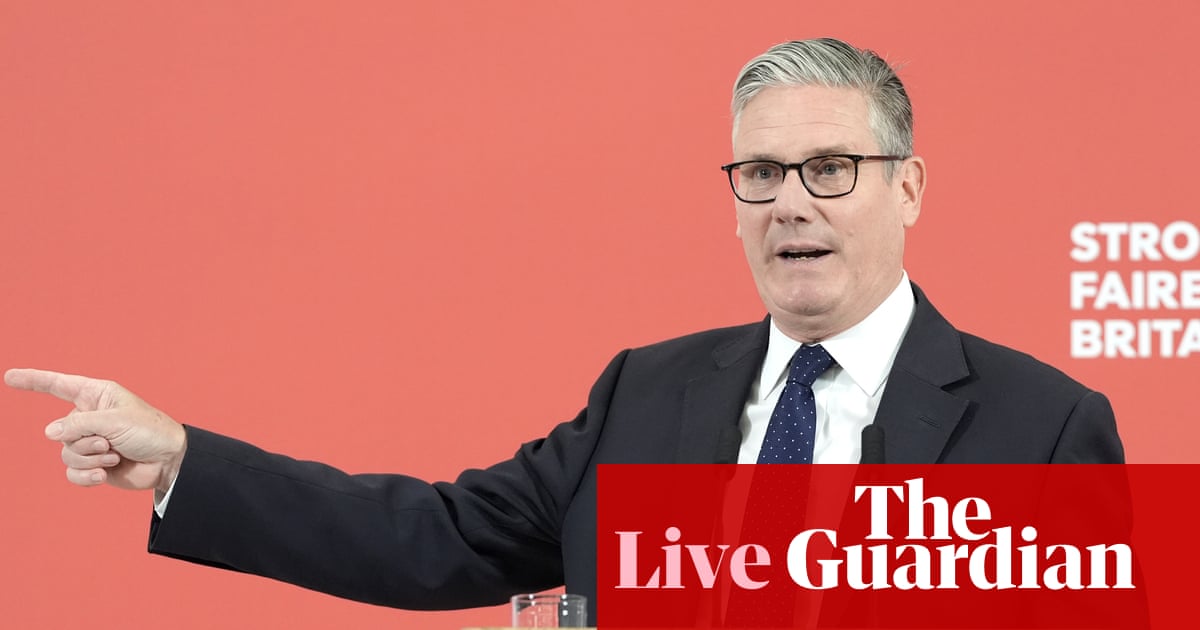
Starmer says some capital projects on roads and energy being shelved to fund Dip
Starmer gives more details of those capital cuts.
It means departments making better use of assets like underused land, and it means those departments with the largest capital budgets contributing more.
Therefore, some capital projects, for example on roads and energy, which are important but not immediately vital, will no longer go ahead as planned.
But this is about taking the necessary choices, the right choices to protect our nation.
And he goes on to confirm the new spending totals.
Now we are already delivering the biggest sustained increase in defence spending since the 1980s – £270 billion over the spending review period.
And I can announce today that under the defence investment plan, we are increasing this by a further £15bn, setting a new record of spending almost £300bn over the next four years to back our armed forces and strengthen our national security.
Key events
Q: [From Sophie Huskisson from the Daily Mirror] What advice do you have for Andy Burnham on how to stop the Treasury and MoD fighting over defence spending?
Starmer started with a tribute to Rachel Reeves. He said:
Let me just say a word or two about the Treasury and about this chancellor, if I may.
We inherited an economy that was broken. and there’s no doubting that, nobody argues about that.
And this chancellor put it on a stable footing. And you saw that in the figures earlier this year, set out in the spring statement; they spoke for themselves.
He said that meant he could “depart the stage” knowing he had left the economy in a better state then before.
On wrangling with the MoD, he said:
At the end of the day, the prime minister and the chancellor have to look at the overall judgments for the government, the overall affordability and priorities between different things.
Departments, of course, will put forward, in good faith the commitments they think we should make. I understand that.
But what we have to do is judge them against what we can afford, what the priorities of the country are.
.
Starmer says he’s ‘100% confident’ in Dip
Q: [From Paul McNamara from Channel 4 News] Many retired defence chiefs say you are not spending enough? Are you just ignoring them, or do you think they are wrong?
Starmer says defence has had its biggest sustained spending increase for 50 years.
He goes on:
It really is going to deliver the capability that we need for the future and that is what it does. That is my judgement call on this, of course.
I hugely respect those with great experience and great service.
There will always be those that say, whatever the sum is, frankly it’s not enough …
I have a job as prime minister to get this judgement right in terms of the amount of money that is spent, the capability that we need as a country. And that is why I’m 100% confident in the plan that we’ve put forward this morning.
Starmer says ‘any Labour PM’ would back Dip – but declines to say explicitly Burnham has approved it
Q: [From Andy Bell from 5 Live News] Has Andy Burnham seen this plan and signed it off?
Starmer says:
The way I put it is this, I don’t think anybody would argue that the strategic defence review was needed.
Any prime minister will want to know what are the capabilities I have at my disposal now …
So that is something which any Labour prime minister would want to stand behind. It’s a platform any Labour prime minister want to stand on because the first duty of any prime minister is the defence and security of the country.
Q: [From Sky’s Beth Rigby] What assurances have you had from Andy Burnham that he will continue to raise defence spending?
Starmer says:
I think a test of any prime minister is whether they leave the country in a better state than they found it. And if you look at our country, that is undoubtedly the case on the economy. Undoubtedly the case on public services, in particular the NHS, but also undoubtedly the case on defence and security and international leadership. We are in a much better state now than we were when we took over two years ago.
And on Burnham he says:
Labour governments have always [prioritised defence and security] and I’m absolutely certain, therefore, that this is a platform on which whoever comes after me can build.
He also says he will do “everything within my power to make sure that any transition is orderly, and that we go from strength to strength”.
Q; [From the BBC’s Chris Mason] General Sir Richard Barrons, one of the authors of the SDR, said Britain is not keeping up with its allies in defence spending, and certainly not with its enemies. Is he wrong?
Starmer says the last government left the armed forces in a hollowed out state.
Defence spending has gone up, he says.
I have to make the right judgements on the capability that I think is right for our country to meet the threats, not just of today, but of tomorrow. And that is what this defence investment plan does.
I think anyone standing back, and objectively, would say this is a massive step forward.
Starmer is now taking questions.
Q: [From ITV’s Carl Dinnen] In the past you have said Russia might attack Nato by 2030. Is there enough in this plan to ensure Britain could fight then if it had to?
Starmer says he does believe that.
That is because of the increase in defence spending that we put in place announced last year, already in place, which was the single biggest sustained increase since the 1980s. And this defence investment plan builds on that. And it’s not just the amount of money, it is also the capabilities.
Starmer says mood in Moscow ‘turning against Putin’s war’
Starmer ended by talking about Ukraine.
There are clear signs that, as Russia’s losses mount and their economy struggles, the mood in Moscow is turning against Putin’s war.
So this is the moment to ramp up the pressure, backing Ukraine’s defence and turning the screws on Russia’s economy. And that is what we’re doing.
Starmer announces £50bn defence export facility to help defence firms
Starmer says the Dip will make the armed forces more effective.
He says it will also boost the economy.
The government is creating a £50bn defence export facility to support British defence businesses, he says.
And he says the plan will also strengthen the UK’s position with its defence allies.
Starmer says defence spending can’t be ‘bottomless pit’, and MoD has to ‘spend better’
Starmer says in the past defence spending “has sometimes been seen as a bottomless pit”.
But this time will be different, he says.
We can’t just spend more. We’ve got to spend better. That includes driving real reforms within the Ministry of Defence to get greater value from our investment, accelerating innovation and procurement, and reducing non-military spending, for example, on civil service staff.
Starmer says he is on course to get defence spending up to 3% of GDP.
We are raising it to 2.7%, putting us on a trajectory to reach 3% in the next parliament, which must be the number one priority at the next spending review.
At last year’s Nato summit, I committed to spend 5% of GDP on our wider security, covering things like energy security and critical infrastructure as well as defence.
The defence investment plan published today takes us to 4.2%.
Starmer says some capital projects on roads and energy being shelved to fund Dip
Starmer gives more details of those capital cuts.
It means departments making better use of assets like underused land, and it means those departments with the largest capital budgets contributing more.
Therefore, some capital projects, for example on roads and energy, which are important but not immediately vital, will no longer go ahead as planned.
But this is about taking the necessary choices, the right choices to protect our nation.
And he goes on to confirm the new spending totals.
Now we are already delivering the biggest sustained increase in defence spending since the 1980s – £270 billion over the spending review period.
And I can announce today that under the defence investment plan, we are increasing this by a further £15bn, setting a new record of spending almost £300bn over the next four years to back our armed forces and strengthen our national security.
Starmer says Dip funded by 1% cuts in capital budgets from other departments
Starmer says the Dip is fully costed.
You have some people in this debate who underplay the threat and deny the need to prioritise defence and security.
You also have those who say you can fund defence without making sacrifices in other areas of capital spending, and you have those arguing that we can just raise borrowing.
But let’s be clear defence bonds [an idea promoted by the Liberal Democrats] are just borrowing by another name.
We’ve looked at this very carefully, but the fact is doing this through borrowing would push interest rates higher at a time when £1 in every ten already goes on paying debt interest, and this government has fought hard to bring the public finances under control, and it has paid off, helping to bring inflation and mortgage rates down.
Starmer says this settlement is within the fiscal rules.
The settlement I’m setting out today is the right choice for the country.
It delivers the decisive action we need on defence in a way that is within our fiscal rules, and that will not take resources away from day to day spending on frontline services like health and education.
Instead, this funded by reallocating spending from across government departments, reallocating capital budgets by one penny in every pound, while still maintaining public investment at the highest sustained levels since the 1970s.
Starmer says the Dip delivers on the strategic defence review, but goes further.
And he says he is confident Andy Burnham will build on it.
Ahead of the Nato summit next week, this plan represents our best judgement of what the country needs to meet this moment, and it is a platform on which I know my successor will build.
Starmer says, to preserve peace, Britain must prepare for war.
We want our people to be able to live in a world defined by peace, stability, and the rule of law.
But the paradox of peace is that when the world is arming and aggression is rising, the best way to avoid war is to prepare for it.
The best way to defend is to deter, to have the strength to make your adversaries think again before they act.
Starmer praises Nato, but says European countries must spend more on their own defence.
My view has been the same since day one. We must stand more firmly on our own two feet. We must do what it takes to meet this new world head on, to keep our country safe and seize the opportunities that come from investing in our sovereign strength.
Starmer also says Ukraine has shown how war is changing.
We also see on the battlefield in Ukraine that the very nature of conflict is changing before our eyes.
Despite having a limited navy, limited traditional air power and limited armour, Ukrainian forces have destroyed the Black Sea Fleet.
They struck deep into Russian territory and stopped the advance of one of the biggest armies in the world.
How have they done that? Through sheer courage, yes, but also by embracing technology.
They’ve integrated drones into their fighting like never before, understanding that the ability to innovate and produce at speed and at scale is more vital than ever to military power.
Starmer says he knows people are worried about the state of world, and the threats to security.
And not all threats are remote, he says.
We see foreign states targeting our nation as well. Thugs hired by foreign powers conducting violence, vandalism and arson on our streets, disinformation aimed at sowing division and stoking disorder, spreading lies and undermining our democracy.
This was in part a reference to the Russian-led plot that led arson attacks on properties linked to Starmer himself.


